
By the Zoye Patio export & engineering team, Ningbo · Last reviewed August 2026
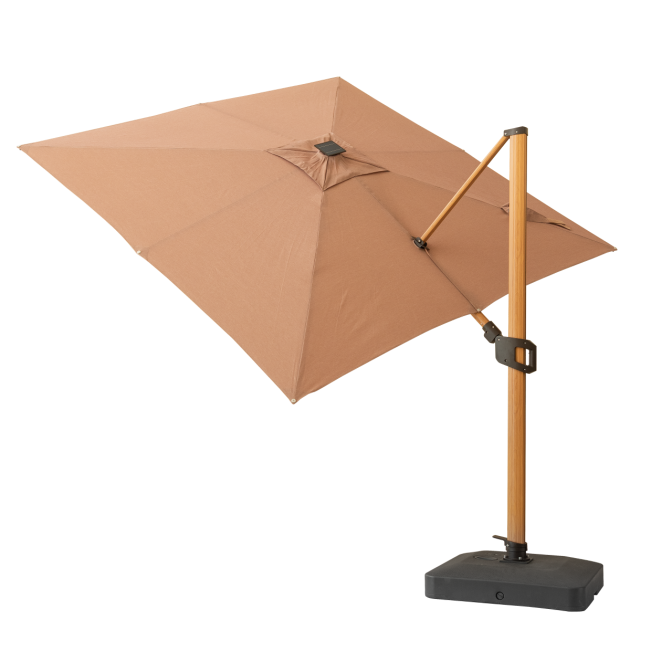
Model 08 from above, canopy fully open with the solar panel at the centre. The seam layout, corner reinforcement and panel symmetry visible here are exactly the checkpoints we sign off during a first-article sample approval.
Most importers arrive at private label the same way: a few seasons selling commodity stock, watching the margin thin out as more distributors carry the identical SKU, until one day the maths on a custom line finally makes sense. The nice surprise at the 3×3M level is that the tooling to make something genuinely your own — a distinct profile, a hub in your brand colour, a printed canopy — is cheap enough that a first run of 300–500 units absorbs it without drama.
The decision usually closes on one figure: importers with exclusive designs tend to report 15–25% better sell-through at the same or higher price than the catalogue lines everyone else is discounting. And the differentiation doesn't need to be dramatic. A mechanism colour matched to your palette and a printed care label do more for perceived quality than most buyers expect. Here's how the programme actually runs.
Phase 1 — Brief and feasibility (weeks 1–2)
A complete brief covers six things. Miss one and you'll usually lose a week or two in back-and-forth before sampling can even start:
Our engineering team usually turns around design-for-manufacturing feedback within 48 hours of a complete brief. Honestly, that response time is a decent litmus test in itself — a catalogue reseller can't give you real DFM notes because they didn't design the product.
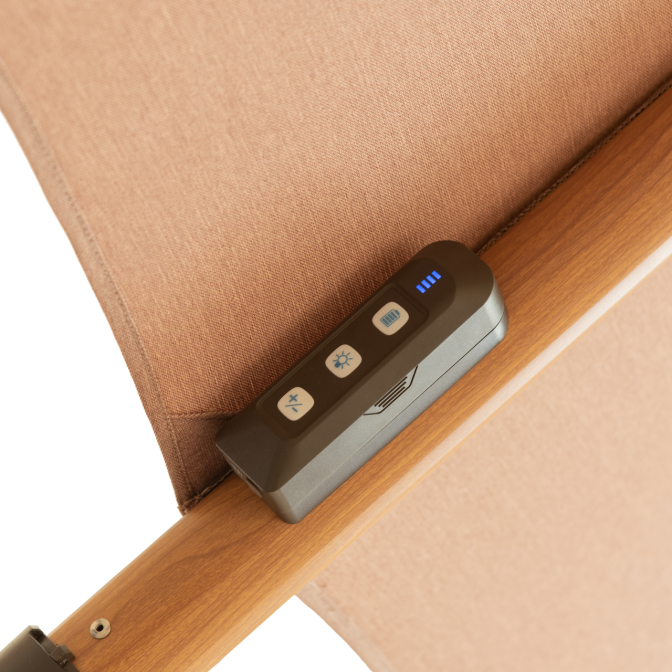
The Model 08's smart controller — brightness, on/off and battery status. On OEM programmes the casing and button layout can be recoloured or branded to your spec.
Phase 2 — Sampling and approval (weeks 3–8)
Two samples carry the programme:
Sample |
Lead time |
Typical cost |
What you're signing off |
Pre-production prototype (PP) |
15–20 days |
USD 300–600 |
Dimensions, mechanism function, geometry |
First-article sample (FAS) |
25–35 days |
USD 500–900 |
Brand colour, fabric, labels, final look |
Production verification |
+7 days after FAS |
Included |
Confirms bulk matches the FAS |
Four things worth testing on the FAS that buyers routinely skip: the canopy's actual UPF on a spectrophotometer (not our stated figure), mechanism torque (≤8 N·m consumer, ≤12 N·m commercial), frame-to-collar clearance (≤0.3 mm, or you get an audible wind rattle at the table), and — if it's EU-bound — the CE marking position against EN 13749. And please, never approve a fabric colour from a monitor. Ask for a physical swatch and look at it in the light it'll actually live under.
Phase 3 — Tooling (weeks 9–13, only if needed)
Custom tooling is only in play if you've specified a non-standard extrusion or a cast hub part. The common variants — 360° rotation, LED, tilt — need no new tooling with us because they're already part of the product architecture. When tooling *is* required:
Item |
Typical cost |
Break-even volume |
Extrusion die (custom profile) |
USD 1,800–3,500 |
~500 units |
Injection mould (hub-cap insert) |
USD 2,500–5,000 |
1,000+ units |
Screen-print jig (canopy logo) |
USD 200–400 |
Any volume |
Put tooling ownership in the manufacturing agreement: buyer-funded tooling should be dedicated to your part numbers, stored at the factory for at least three years, and transferable if the relationship ends. We've seen enough messy exits to recommend that in writing every time.
Phase 4 — Compliance and certification
Scope depends on where the product lands, and buyers routinely underestimate how long this takes.
Market |
Primary standards |
Form |
Cost |
Timeline |
EU |
EN 13749 + REACH |
CE Declaration of Conformity |
USD 800–2,000 |
4–6 wks |
US |
ASTM F1836 + Prop 65 (CA) |
Self-declaration + test report |
USD 600–1,500 |
3–5 wks |
Australia |
AS/NZS 4836 + 4399 UPF |
Third-party test report |
USD 700–1,800 |
4–6 wks |
GCC |
GSO / SASO equivalent |
Third-party certification |
USD 1,000–2,500 |
6–8 wks |
We can coordinate SGS or Bureau Veritas testing as part of the OEM package. Build these weeks into your launch calendar — this phase compresses badly if a PP sample needs a dimensional change right before testing.
So how long, really?
From a complete, approved brief to bulk at your destination port: 16–20 weeks with new tooling, 12–15 weeks if you're using existing tooling with a custom finish and canopy. The two things that blow the schedule are always the same — buyers who cycle through several colour rejections on the FAS, and lab queues in peak season (2–4 weeks is normal). Neither is a factory problem; both are plannable.
The honest summary
A private-label cantilever programme is achievable at 300–500 units with tooling costs a mid-size distributor can justify in a single season. The buyers who run it cleanly all share one habit: they show up with a complete brief and approve samples quickly. The ones who struggle are usually trying to minimise sample count while changing the spec — the most expensive way to save money there is.
Ready to put a brief in front of our OEM team? Email [email protected] or WhatsApp +86-18158255610 and we'll send back a development timeline.
Article 4 of 10 · Zoye Patio B2B Sourcing Series
Ningbo Zoye Patio Technology Co., LTD specializes in premium garden shade and lighting products. From durable umbrellas and retractable awnings to elegant solar and LED lights, we create functional and stylish outdoor spaces that enhance comfort and beauty day and night.
1807 18th Floor, Lippo Centre Tower 1, 89 Queensway, Admiralty, Hong Kong
Copyright © 2026 Ningbo Zoye Patio Technology Co., LTD. All rights reserved. Privacy Policy
 EN
EN