
By the Zoye Patio export & engineering team, Ningbo · Last reviewed August 2026
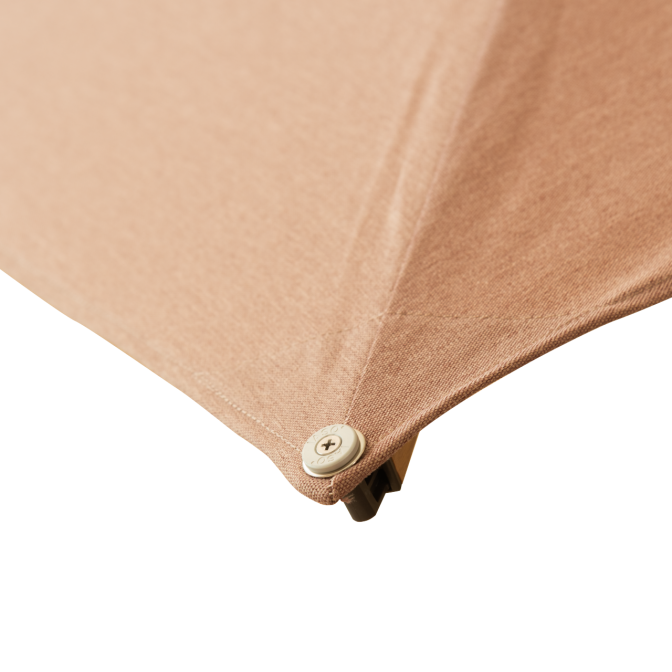
A canopy corner on the Model 08 — the turned hem, double-stitched seam and screw-fixed clip. This little corner is where a canopy either keeps its tension for years or starts to pull loose after one windy season.
Walk any outdoor-furniture trade show and you'll see "UV-resistant" printed on practically every umbrella. It's the most confident meaningless phrase in the industry. Without a UPF number, a test standard and a current lab report behind it, it commits the supplier to nothing — and leaves *you* holding the risk.
That risk is very real once money is involved. Warranty programmes, retailer onboarding, product-liability exposure in hospitality — they all rest on documented fabric performance. If you're signing a five-year supply deal with a hotel group, the certification trail is what you stand behind when a claim lands. A supplier's verbal assurance is not part of that trail. So here's what the paperwork actually needs to say.
UV performance: UPF and the standard behind it
UPF (Ultraviolet Protection Factor) is simply how much UV the fabric lets through. UPF 50 means one-fiftieth gets past — a 98% block. For commercial work:
How the fabric families compare
Fabric |
UPF |
Colour retention |
Typical commercial warranty |
Solution-dyed acrylic (Sunbrella-grade) |
50+ |
Excellent — 2,000+ UV hours |
5–10 yrs |
Terylast-grade polyester |
50+ |
Good — 1,200–1,500 UV hours |
3–10 yrs |
Olefin (polyolefin weave) |
50+ |
Good — 1,000–1,200 UV hours |
3–5 yrs |
Standard coated polyester |
30–40 |
Fair — 400–600 hours |
1–2 yrs |
We offer a Terylast canopy with a 10-year warranty option, which lines up with the lab data for Terylast-grade polyester and is backed by end-user documentation from European commercial installs. It's the sweet spot for buyers who need a real warranty without an acrylic price tag.
Wind load: turning a marketing claim into a number
The Beaufort scale is the cleanest shared language for wind resistance, so we spec against it:
Beaufort |
Wind speed |
Application |
5 |
29–38 km/h |
Absolute minimum for any commercial install |
6 |
39–49 km/h |
Open restaurant terrace, hotel courtyard |
7 |
50–61 km/h |
Coastal resort, exposed rooftop |
8+ |
62+ km/h |
Only with fixed anchoring and purpose-built frames |
A standard 3×3M with twelve aluminium ribs, 300 g/m² fabric and a 90 kg base typically holds Beaufort 6–7 in controlled testing. Worth stressing: wind rating is a *system* property. It's not the fabric alone — it's rib count, frame rigidity and base mass working together. A supplier quoting a wind number without specifying the base is quoting half an answer.
Compliance, market by market
European Union — EN 13749 structural test report, a REACH declaration (restricts chemicals in dyes and coatings), and a CE Declaration of Conformity for any LED components.
United States — an ASTM F1836-04 performance report, California Prop 65 documentation for anything sold in CA, and a CPSC general conformity certificate for consumer products.
Australia / New Zealand — AS/NZS 4836 for safety and hazard signage, plus an AS/NZS 4399 UPF report if you're making a UV-shade claim.
One thing that trips up first-time importers: "current" in practice means within 24 months for most retailers and hospitality buyers — not the age of the standard itself. Ask for reports with a visible issue date and flag anything older than two years as a re-test before you onboard the supplier.
A quick FAQ
Is Terylast as good as Sunbrella?
For most commercial applications outside the harshest UV climates, it's a very strong value choice — 50+ UPF and a long warranty at a materially lower cost. Sunbrella-grade acrylic still leads on absolute colour retention if that's the priority.
What fabric weight should I specify?
Around 300 g/m² is the practical commercial floor. Lighter fabrics feel fine in the showroom and disappoint under sustained wind and UV.
Bottom line
Fabric is where a lot of umbrella programmes quietly accumulate risk. The documentation trail — UPF standard, report issue date, issuing lab, REACH status — is what makes your warranty enforceable and your retailer onboarding smooth. Ask for it before the order, not after the first claim. (Our supplier-audit checklist folds this into a full pre-order review.)
Need our full certification pack for your target market? Email [email protected] or WhatsApp +86-18158255610.
Article 5 of 10 · Zoye Patio B2B Sourcing Series
Ningbo Zoye Patio Technology Co., LTD specializes in premium garden shade and lighting products. From durable umbrellas and retractable awnings to elegant solar and LED lights, we create functional and stylish outdoor spaces that enhance comfort and beauty day and night.
1807 18th Floor, Lippo Centre Tower 1, 89 Queensway, Admiralty, Hong Kong
Copyright © 2026 Ningbo Zoye Patio Technology Co., LTD. All rights reserved. Privacy Policy
 EN
EN