
By the Zoye Patio export & engineering team, Ningbo · Last reviewed August 2026
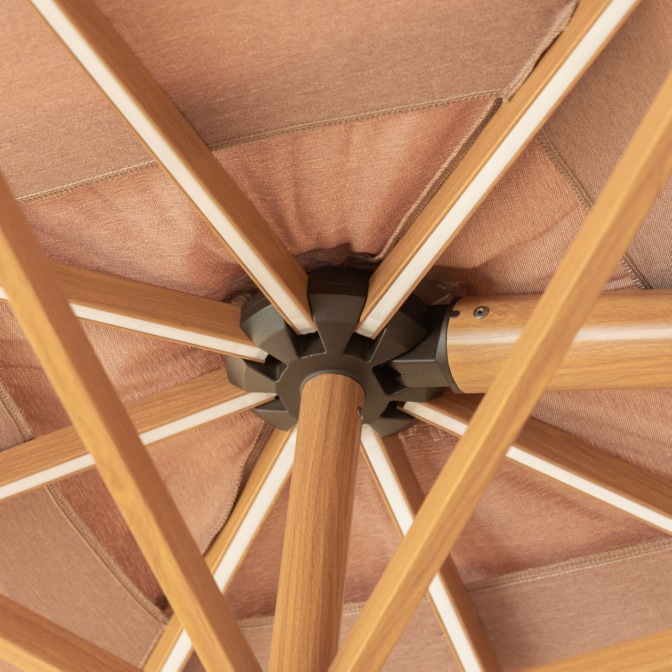
Looking straight up into the Model 08 hub. All eight ribs feed their load into one cast node here — the geometry of this joint, more than the marketing, decides how the frame ages.
Here's a number that comes up in almost every price negotiation: twelve dollars. That's a fairly typical per-unit gap between two 3×3M cantilever frames that, on paper, read the same. Buyers assume it's margin, or volume, or someone being greedy. Usually it's neither. It's a decision made way upstream, at the material spec, and it doesn't reveal itself at inspection. It reveals itself when a beachfront property replaces sixty umbrellas in year three instead of year nine.
Frame material is where unit cost and total cost of ownership quietly part ways. So let's walk through what the three main families actually give you in commercial service — from the inside of a factory that machines all three.
Aluminium alloy (6063-T5 / 6061-T6)
This is the export standard for umbrellas headed to North America, Europe and Australia, and for good reasons that go beyond habit.
Aluminium is light — about 2.70 g/cm³, roughly a third of mild steel. That matters twice: once in your freight cost per container, and again for whoever has to reposition the umbrella on a busy terrace. Strength is a non-issue for umbrella loads; 6063-T5 yields at around 145 MPa and 6061-T6 at 275 MPa, both comfortably past what a cantilever arm sees.
Corrosion is where aluminium really earns its place. It forms its own oxide skin the moment it meets air, and anodising thickens that into a controlled 15–25 micron layer that shrugs off salt spray in a way powder-coated steel simply doesn't. For premium hospitality accounts where the frame finish is part of the look, we run a mirror-anodised finish that also happens to be far more forgiving in coastal air.
One honest caveat, and it's the important one: the temper on the certificate only means something if the process protects it. MIG welding at a load-bearing collar can knock 15–30% off 6063-T5's local yield strength. TIG welding with the right post-weld protocol keeps it. When you qualify a factory, ask specifically how they weld the arm collar — the answer tells you whether they understand their own material.
Powder-coated steel
Steel frames still sell, mostly where the first invoice matters more than the fifth year.
At 7.85 g/cm³ steel is nearly three times aluminium's weight, so you pay for it again in ocean freight. Its strength (250–350 MPa) is frankly wasted on an umbrella — you're shipping mass you don't need. And the coating is the *only* thing standing between the frame and rust. Without a proper epoxy primer, powder coat starts failing in salt-spray testing around the 500-hour mark, which is maybe 18–24 months of real coastal exposure. Once it cracks at a weld, corrosion runs underneath the coating where you can't see it until the frame is already compromised.
For anyone supplying hotel groups on multi-year maintenance contracts, steel is a hard case to make once you model the lifecycle past year three.
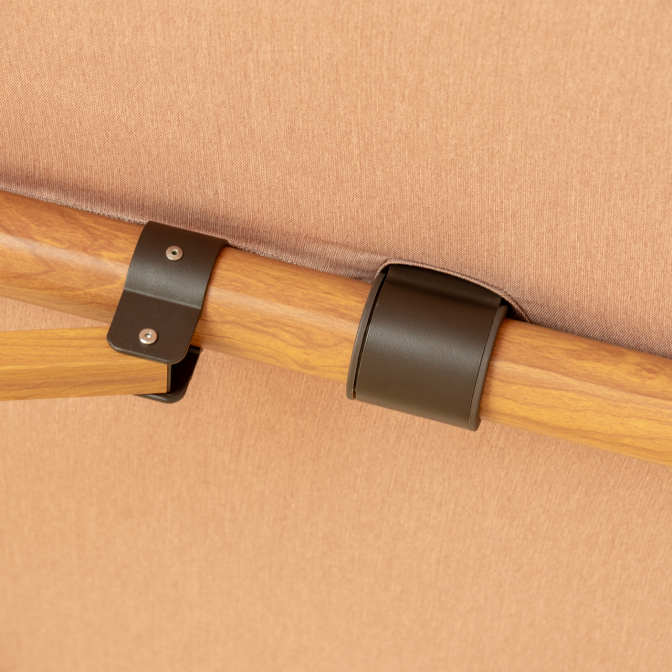
A fabric-to-rib clamp on the Model 08 — dark-anodised aluminium clips hold the canopy against wind lift at each rib midpoint. The grade and finish of hardware at these contact points quietly decides how long the fabric survives.
Fibreglass — for ribs, not posts
You almost never see fibreglass as a main post, and you shouldn't. As a *rib* material, though, it does one specific job well: it flexes instead of resisting. Under a sudden gust the canopy deflects and springs back rather than snapping a rigid aluminium rib. That's genuinely useful on beachfront and exposed rooftop sites in hurricane-adjacent regions.
It costs 20–35% more than aluminium ribs, so it's a spec you choose deliberately when wind-event risk is a known liability, not a default. We offer it as an option for buyers with sites that warrant it.
Side by side
Property |
6063-T5 aluminium |
Powder-coated steel |
Fibreglass ribs |
Main post weight (3 m) |
~4.2 kg |
~12.8 kg |
n/a (ribs only) |
Salt-spray resistance |
Excellent (anodised) |
Fair |
Excellent |
Commercial service life |
8–12 yrs |
3–6 yrs |
10+ yrs |
Field repairability |
High — collar sections swap out |
Moderate |
Low |
FOB vs steel post |
+15–25% |
Baseline |
+30–40% on ribs |
EU / N. America position |
Dominant |
Declining |
Niche |
The two questions that separate a factory from a trader
When you're on a qualification call, these two do a lot of work:
A genuine manufacturer answers the second one with specifics. A reseller changes the subject. (If you want the whole vetting routine, it's in our supplier due-diligence checklist, and the production side is in the seven-stage factory walk-through.)
The takeaway
Material choice is the single biggest lever on how long these umbrellas last in the field, and it's almost invisible at the point of purchase. Aluminium wins on nearly every axis that matters commercially; steel survives on first-cost sensitivity; fibreglass earns a place on the ribs of high-wind sites. Spec the frame deliberately and the rest of the umbrella tends to follow.
Want our material datasheet and a sample FOB price on a spec you're weighing? Reach us at [email protected] or WhatsApp +86-18158255610.
Article 2 of 10 · Zoye Patio B2B Sourcing Series
Ningbo Zoye Patio Technology Co., LTD specializes in premium garden shade and lighting products. From durable umbrellas and retractable awnings to elegant solar and LED lights, we create functional and stylish outdoor spaces that enhance comfort and beauty day and night.
1807 18th Floor, Lippo Centre Tower 1, 89 Queensway, Admiralty, Hong Kong
Copyright © 2026 Ningbo Zoye Patio Technology Co., LTD. All rights reserved. Privacy Policy
 EN
EN