
By the Zoye Patio export & engineering team, Ningbo · Last reviewed August 2026
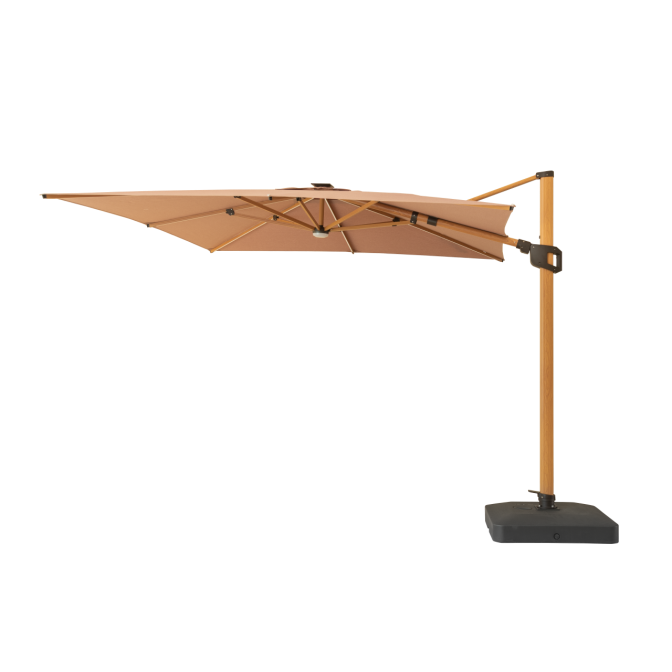
Our 3×3M Model 08 cantilever umbrella, shot on a finished unit before packing — wood-grain aluminium post, eight-rib square canopy, weighted base. This is the configuration most of our wholesale buyers start from.
Almost every week someone emails us a competitor's catalogue page and asks, in effect, "can you match this price?" We usually answer with a question of our own: match it on what, exactly? Because the umbrella in the photo and the umbrella that survives three summers on a hotel terrace are rarely the same product, even when they look identical in a listing.
That gap — between what a spec sheet says and what shows up on a container three years later — is really what this guide is about. If you buy patio umbrellas for resale, for a hospitality group, or for your own retail brand, these are the things we wish more buyers asked us before the deposit, not after the first warranty claim.
Commercial and residential umbrellas are not the same category
It's tempting to think a "commercial" umbrella is just a sturdier version of the one on someone's back patio. In practice they live completely different lives. A hotel unit gets opened and closed by a rotating cast of seasonal staff, sits through the harshest UV hours every single day, gets crammed into a store room each winter, and — this is the part buyers forget — has to be repairable without pulling a whole matching set out of service.
A consumer umbrella, by contrast, gets moved twice a season and folded at the first grey cloud. Build a frame for that duty cycle and put it on a restaurant terrace, and you're signing up for a replacement programme you didn't budget for.
So the four things worth getting right at the sourcing stage are the frame, the canopy geometry, the fabric certification, and the supplier behind all three. Let's take them in order.
Frame engineering: the numbers that actually change performance
If you only interrogate one part of the quote, make it the frame. Here are the thresholds we'd put in a purchase spec and defend:
On our floor we machine the collar assembly at the cantilever-arm joint on CNC rather than hand-fitting it, because that joint is where the cheaper frames crack first. None of this is exotic engineering — it's just the difference between a factory that controls the process and a trading company that assumes it. If you want the full material argument, we broke it down in our aluminium-vs-steel-vs-fibreglass comparison.
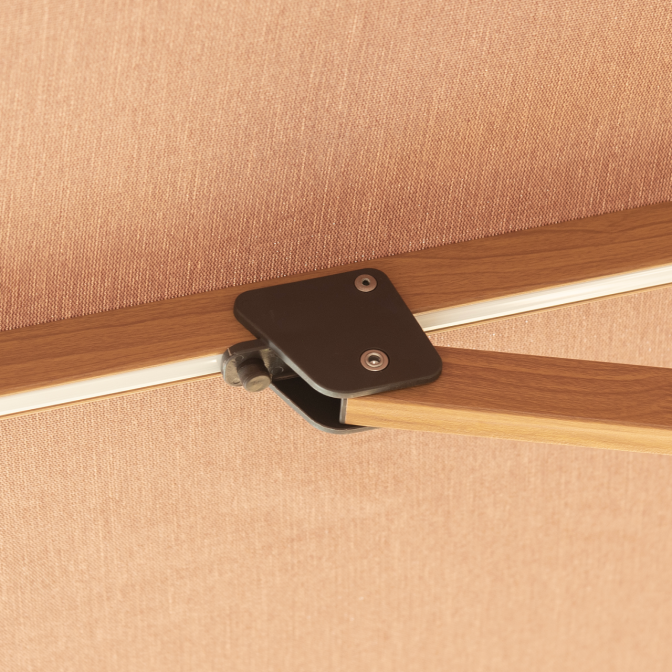
The folding hinge on the Model 08 arm — a multi-bolt cast housing rather than a single pin. Single-pin joints are the classic failure mode on low-cost frames under repeated commercial cycling.
"UV-resistant" is not a fabric spec
This phrase is on nearly every umbrella listing on earth and it means almost nothing on its own. What you actually want is a UPF number tied to a test standard:
Four documents to pull before you agree an MOQ
If a supplier can't produce these quickly, treat it as a signal rather than an inconvenience:
We keep a current documentation pack ready because buyers ask for it constantly; a factory that has to "look for it" usually doesn't have it. There's a fuller supplier-audit framework in our due-diligence checklist if you want to go deeper.
A couple of questions we get asked a lot
What MOQ should I expect for a first order?
For a stocked configuration we can start conversations well below the legacy 200-unit thresholds; custom colour or branding is where minimums climb. It's worth asking rather than assuming.
The short version
Getting a commercial cantilever umbrella right is mostly about knowing which four or five specs create real-world differences and ignoring the cosmetic ones. Alloy temper, rib count, fabric UPF, and a supplier who can hand over documentation on request — that's where durable B2B relationships get built, and where warranty disputes get avoided.
If you'd like a specification-matched quote and our current audit pack, email [email protected] or message us on WhatsApp at +86-18158255610 — we usually turn around a factory FOB quote within a day.
Article 1 of 10 · Zoye Patio B2B Sourcing Series

Ningbo Zoye Patio Technology Co., LTD specializes in premium garden shade and lighting products. From durable umbrellas and retractable awnings to elegant solar and LED lights, we create functional and stylish outdoor spaces that enhance comfort and beauty day and night.
1807 18th Floor, Lippo Centre Tower 1, 89 Queensway, Admiralty, Hong Kong
Copyright © 2026 Ningbo Zoye Patio Technology Co., LTD. All rights reserved. Privacy Policy
 EN
EN