
By the Zoye Patio export & engineering team, Ningbo · Last reviewed August 2026
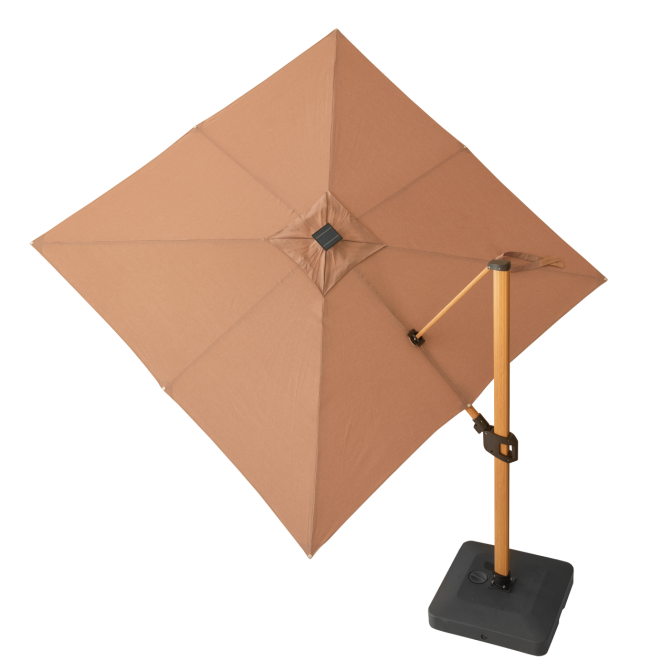
Top-down on the Model 08 with its solar panel and integrated LED at the hub — the "dual-function canopy" that used to be a premium curiosity and is now turning up in mainstream commercial specs. This shot captures a lot of where the category is heading.
For most of the last decade, patio umbrellas were a comfortable import category — steady volumes, predictable seasons, a manageable supplier pool. You could run last year's playbook and be roughly right. That's no longer true. Five forces are pushing on the category at once, and none of them are speculative: we see them in tender specs, in retailer onboarding requirements and in how our distributors are placing forward orders right now. Here's what's moving, and what each shift means for how you buy.
Shift 1 — Canopies are getting bigger, faster than buyers expect
The commercial channel has drifted from a 2.7 m average canopy toward 3.0–3.5 m over the past three years. In 2026 it crossed a line where it's shaping inventory decisions, not just preferences. Hotels are specifying fewer, larger umbrellas per zone to cut anchor points, simplify maintenance and give guests a more continuous shade experience. Premium residential buyers in North America are retiring 2–2.4 m market umbrellas for 3 m cantilevers — demand that flows straight through the wholesale channel. And European urban F&B operators are squeezing maximum coverage out of tight terrace footprints, which means bigger canopies over more seats.
What it means for you: smaller factories often subcontract 3.5 m orders, and that's exactly where the quality-control gap opens up at the worst moment. Confirm your supplier has in-house capacity for the *size in your forward plan* — not just the size you bought last season.
Shift 2 — "Smart outdoor" is sliding from premium into standard
Motorised cantilever umbrellas — remote rotation, app-dimmable LED — grew an estimated 38% by volume in the European B2B channel through 2025, and that growth is now pulling down into the mid-market as the mechanism cost premium compresses. Products moving into mainstream commercial spec in 2026 include 12V DC motorised hub rotation with a handset (integration-ready for hotel building-management systems over RS-485 or Zigbee), dual-function canopies that pair shade with solar for an LED ring and a USB charge point, and tunable-white LED (2,700–6,500K) so an F&B operator can program ambience across service periods.
What it means for you: smart products need *certified* electrical components — UL, CE, SAA — and the certification trail has to be current. Non-certified drivers and LED circuits are increasingly triggering retailer compliance rejections and customs holds. Ask for component certification numbers, not logos. (Article 8 breaks down the LED options in practical terms.)
Shift 3 — EU sustainability moved from marketing into the spec sheet
The EU's Sustainable Products Regulation, in phased rollout since 2024, has quietly promoted recycled content and end-of-life planning from brand-brochure language into the actual requirements of public-sector and major-retailer tenders. What's showing up in European specs this year: ≥30% post-consumer recycled aluminium as a scored criterion in a growing share of outdoor-furniture tenders; tightening VOC limits that put solvent-based powder-coat primers under scrutiny; and, in some member states, EPR take-back enrolment or fees due at the import stage.
What it means for you: start asking suppliers for Material Declaration Sheets and recycled-content certificates well before Q1 2027. The ones who can't produce them in the next twelve months will be quietly disqualified from an expanding slice of European tenders — and you don't want to discover that mid-bid.
Shift 4 — Dual-sourcing is replacing single-supplier dependency
After the 2020–2022 supply-chain squeeze, most large outdoor-furniture importers moved from a single source to a dual-source strategy. What's changed in 2026 is how specific the criteria for that second source have become:
Criterion |
What buyers now require |
MOQ flexibility |
50-unit minimums; the old 200+ threshold kills too many fill-in orders |
Factory-held buffer stock |
4–6 weeks of top SKUs, available at standard pricing for fast fulfilment |
Direct container booking |
Factory-level coordination that skips the forwarder markup |
ERP-compatible tracking |
Real-time production status that plugs into buyer-side systems |
The direction is away from "cheapest primary source, no backup" and toward a tiered model where the second source is pre-qualified, sample-approved and ready to switch on within a single PO cycle.
Shift 5 — Private label is accelerating at the mid-market
The economics have tipped. OEM tooling (USD 3,000–6,000 per distinct SKU) has stayed flat or fallen as a share of total programme cost, while the premium a private-label line commands over commodity catalogue product has grown. In practice, importers running custom canopy colours, branded hub caps and exclusive mechanism finishes report 15–25% better retail sell-through at equal or higher price points than the commodity SKUs everyone else is discounting into the ground.
What it means for you: the minimum viable OEM programme with us starts around 300–500 units with selective tooling. If you're approaching that volume for the first time, model the tooling against a two-season sell-through projection — at 15% better sell-through, the tooling usually pays itself back inside the first season. (Article 4 is the full OEM roadmap.)
Where this nets out
These five shifts aren't spread evenly. They're concentrated in commercial hospitality, premium residential and European distribution — the segments where margins have always been best. If you already play there, you have the most to gain from adjusting your sourcing parameters now, and the most to lose from treating 2026 like a rerun of 2024. The importers quietly re-tooling their supplier mix this year are the ones who'll look prescient in 2027.
Want our 2026 catalogue and a trend briefing tailored to your markets? Email [email protected] or WhatsApp +86-18158255610.
Article 10 of 10 · Zoye Patio B2B Sourcing Series
Ningbo Zoye Patio Technology Co., LTD specializes in premium garden shade and lighting products. From durable umbrellas and retractable awnings to elegant solar and LED lights, we create functional and stylish outdoor spaces that enhance comfort and beauty day and night.
1807 18th Floor, Lippo Centre Tower 1, 89 Queensway, Admiralty, Hong Kong
Copyright © 2026 Ningbo Zoye Patio Technology Co., LTD. All rights reserved. Privacy Policy
 EN
EN