
By the Zoye Patio export & engineering team, Ningbo · Last reviewed August 2026
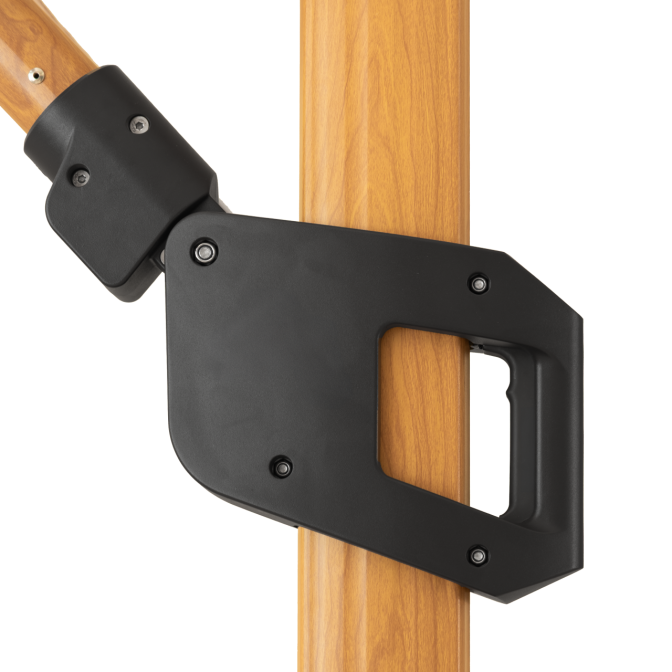
The tilt-and-rotation lock on the Model 08. This open-handle bracket ties the cantilever arm to the post and controls both arm angle and canopy position — it's the exact part buyers are comparing when a quote just says "mechanism type."
Procurement teams rarely get briefed on umbrella mechanisms, so specs quietly default to "tilt" without saying which kind. That's a costlier shortcut than it looks. The gap between a basic single-tilt and a 360° rotation unit isn't an upgrade fee — it's the difference between a terrace where staff drag bases around all afternoon chasing the sun, and one where a fifteen-second adjustment sorts it out.
Before you spec a mechanism, answer one question: across a full operating day, what does this umbrella actually need to *do*?
Single-direction tilt
The baseline. The canopy tilts in one plane, usually toward the sun, and locks. Range is 0–45° on most models, some reach 60°, with a ratchet or lever lock at 6–10 N·m engagement.
It works where the sun's path is predictable across your service window — an east-facing breakfast terrace, say. It fails anywhere guests need shade from shifting directions without someone relocating the base. A single-tilt gives you shade in one vector; the sun moves; by mid-afternoon the umbrella is covering half a table and an empty chair.
Left-right bilateral flip
A step up that adds tilt in two opposing directions. A collar-mounted lever or push-button lets the canopy flip between two axes. In practice it lifts effective shade coverage by around 35% over single-tilt across the same sun arc, without touching the base. Best fit: narrow terraces and balconies where the table orientation varies and shoving the base around isn't practical (or isn't allowed).
360° full rotation
The standard spec for hotel pool decks, resort dining and any F&B setting with variable seating. The hub rotates freely around the post, so the canopy can point any direction without moving the base.
The detail that matters here is the bearing. A sealed ball-bearing race is the correct commercial spec; a nylon bushing is fine for low-cycle residential use but wears out under daily commercial cycling. Locking is by friction collar or an indexed pin at 15°/30° steps — the indexed pin gives repeatable positioning that untrained staff find much faster. Operation should sit at ≤8 N·m on a healthy sealed bearing; if it climbs past 10, the bearing is worn or contaminated.
Our 360° mechanism holds ≤8 N·m through 3,000+ rotation cycles in accelerated wear testing — call it three full commercial seasons of twice-daily repositioning. It's documented across our patent portfolio, which is the boring but real reason it doesn't loosen up mid-season.
At a glance
Spec |
Single tilt |
Bilateral flip |
360° rotation |
Sun tracking across a day |
Limited |
Moderate |
Complete |
Ease for untrained staff |
Simple |
Moderate |
Simple (indexed lock) |
Maintenance interval |
Low |
Low |
Low–moderate |
Approx. part count |
~12 |
~18 |
~24 |
Relative unit cost |
1.0× |
1.3× |
1.4× |
Recommended for hospitality |
No |
Marginal |
Yes |
LED: two ways to light an evening terrace
If you serve after dark, you're choosing between solar and wired — and site infrastructure usually makes the call.
Solar LED puts a 5 W monocrystalline panel on the canopy top with a 2,000–5,000 mAh li-ion battery, giving 4–6 hours at half brightness after a good charge. The honest limitation: output sags on cloudy days and when the canopy tilts away from the sun. In northern European markets that's a seasonal reliability issue, not a year-round solution.
Wired LED (12V DC) runs off a supplied transformer or your site's low-voltage landscape system, routed through the post with weatherproof connectors at the base. It needs UL/CE/SAA certification on the electrical parts, but it gives consistent, dimmable output with no weather dependency. Practical tip: plan the conduit into the base paving at install — retrofitting wired LED into a base that's already set in concrete costs far more than doing it up front.
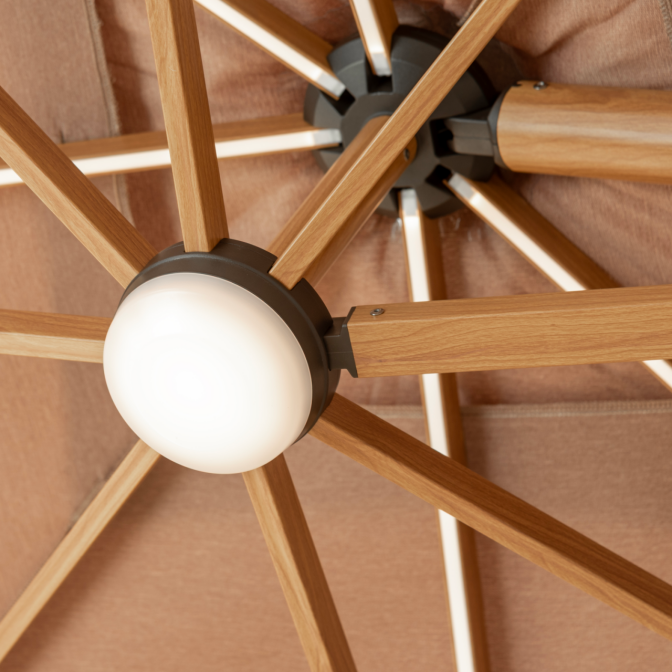
Underside of the Model 08 hub with the central frosted LED globe lit. It diffuses light down across the table zone and, in this configuration, runs off the solar panel on the canopy top.
Our wired models use CE-certified driver circuits and IP44-rated strips, rated for covered outdoor use.
The takeaway
Mechanism choice is a 5–10 year decision in a commercial install. The cost delta between single-tilt and 360° rotation is roughly 40% on that one component — modest against the total project, and significant against the daily friction of managing a terrace full of mismatched shade. Spec it for the work the umbrella does, not for the line on the quote. (Article 7 shows how each mechanism moves the FOB price.)
Want our mechanism spec guide for your project? Email [email protected] or WhatsApp +86-18158255610.
Article 8 of 10 · Zoye Patio B2B Sourcing Series
Ningbo Zoye Patio Technology Co., LTD specializes in premium garden shade and lighting products. From durable umbrellas and retractable awnings to elegant solar and LED lights, we create functional and stylish outdoor spaces that enhance comfort and beauty day and night.
1807 18th Floor, Lippo Centre Tower 1, 89 Queensway, Admiralty, Hong Kong
Copyright © 2026 Ningbo Zoye Patio Technology Co., LTD. All rights reserved. Privacy Policy
 EN
EN